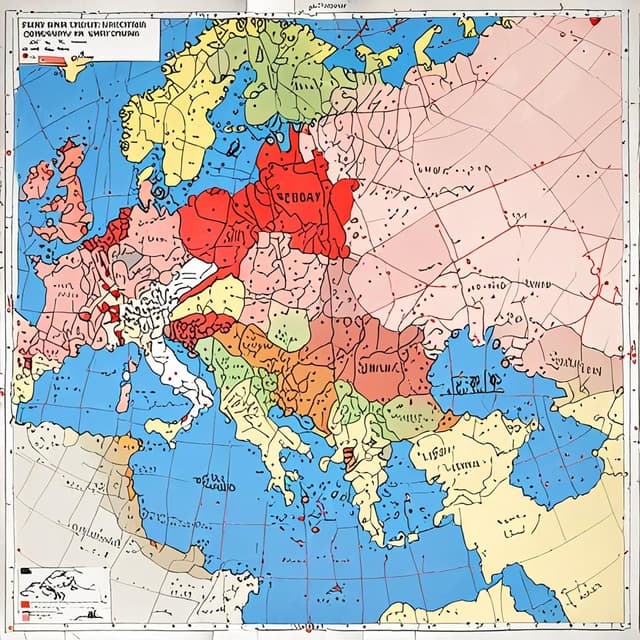
| Year | 1991 |
| Event | Soviet Union remained a global superpower |
| Description | The Soviet Union maintained control over a vast network of client states and satellite nations across Eastern Europe, Central Asia, and the developing world, despite some Soviet republics gaining nominal independence. |
| Key Countries | Poland • Hungary • Cuba • North Korea |
| Affected Regions | Eastern Europe • Central Asia • Developing world |
| Relationship to the West | The Soviet-led Eastern Bloc was still viewed as a threat by the West, despite the communist world persevering through the early 1990s and beyond. |
In 1991, the Soviet Union remained a global superpower controlling an extensive network of client states and satellite nations across Eastern Europe, Central Asia, and the developing world. Though the Soviet system faced growing internal pressures and economic stagnation, the communist world order persisted well into the 1990s and beyond in this alternate timeline.
The Warsaw Pact continued to bind much of Eastern Europe firmly to the Soviet sphere of influence. Poland, Hungary, and Czechoslovakia remained communist dictatorships under the control of Moscow-backed regimes. East Germany also stayed within the Eastern Bloc after failing to reunify with West Germany.
Yugoslavia, which had previously maintained a degree of independence from the USSR, fractured into a series of Soviet-aligned states including Serbia, Croatia, Bosnia and Herzegovina, and Macedonia. Albania also continued its alliance with the Soviet Union.
The Soviet republics of Central Asia - Kazakhstan, Kyrgyzstan, Tajikistan, Turkmenistan, and Uzbekistan - retained their status as constituent parts of the USSR. Moscow maintained tight political, economic and military control over these resource-rich regions.
The formerly independent Baltic states of Estonia, Latvia and Lithuania were also forcefully reintegrated into the Soviet Union after failed attempts at secession in the late 1980s. Their populations continued to resist foreign rule.
The Soviet Union also extended its influence to the developing world, supporting the rise of Marxist-Leninist regimes in nations across Africa, Asia, and Latin America. Prominent examples included Cuba, North Korea, Vietnam, Angola, Mozambique, and Nicaragua.
These Soviet client states received economic aid, military assistance, and diplomatic backing from Moscow in exchange for ideological alignment and economic integration into the Eastern Bloc. Their command economies and one-party political systems mirrored the Soviet model.
Despite the USSR's global reach, the communist world order faced growing internal challenges and external pressures in the early 1990s. Economic stagnation, nationalist separatism, and popular unrest threatened the stability of Soviet hegemony in many regions.
The United States and its NATO allies continued to view the Eastern Bloc as a major geopolitical adversary, leading to ongoing military buildups, proxy conflicts, and diplomatic tensions between the superpowers. However, the collapse of communist regimes that occurred in our timeline never materialized, and the Soviet Union persevered as a global force to be reckoned with.
